
The formula
- Length and width come from the inside of the forms.
- Depth is the measured thickness, converted from inches to feet.
- Divide cubic feet by 27 to get cubic yards.
Worked example
Compare a 14 ft × 10 ft pad at 4 in and 5 in thick.
- Convert the depth
4 in ÷ 12 = 0.333 ft.
- Multiply the dimensions
14 × 10 × (4 ÷ 12) ≈ 46.7 ft³.
- Compare the deeper pour
At 5 in the same pad needs 58.3 ft³.
Practical guide
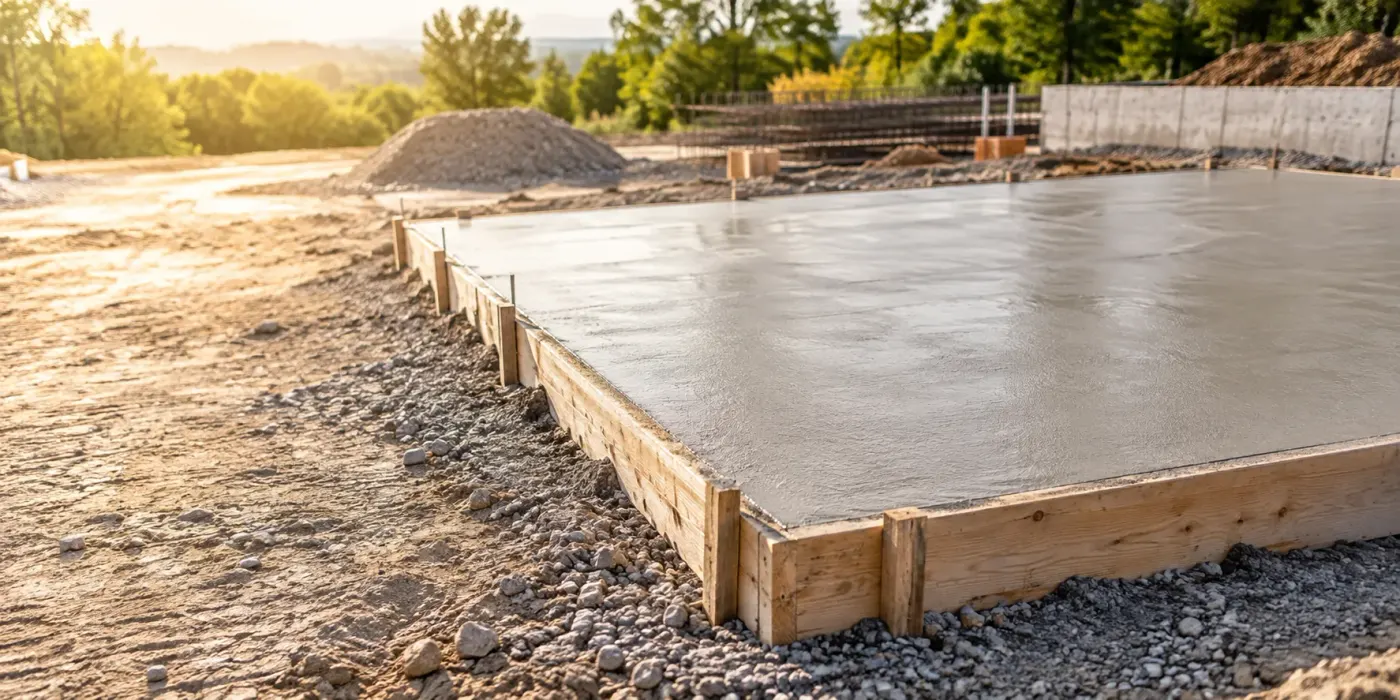
A slab can look like an area problem until the truck arrives. The form boards outline a rectangle, but the concrete has to fill volume: length × width × depth. If the base is lower than planned, every square foot of the slab takes a little more concrete.
Consider a 14 ft × 10 ft pad. At 4 in thick, its geometric volume is 14 × 10 × (4 ÷ 12) = 46.7 ft³, or 1.73 yd³. At 5 in thick, the same footprint needs 58.3 ft³, or 2.16 yd³. That extra inch adds roughly 0.43 yd³—a 25% increase. It is easy to miss because the top view has not changed at all.
Measure the cavity, not the sketch
Use the formwork’s inner edges as the endpoints for length and width. Then check the distance from the planned finished surface down to the prepared base in several places. A single depth reading at the high spot can understate the pour. If one section is intentionally thicker, split the slab into measured zones instead of averaging away a meaningful difference.
A thickened edge needs particular care. First calculate the regular slab across the full footprint. Then add only the extra depth below that slab for the edge strip. Counting the full edge depth a second time counts part of the slab twice.
Keep the order allowance separate
The 1.73 yd³ figure above is the clean geometric volume. With a hypothetical 5% planning allowance it becomes about 1.81 yd³; rounded up to tenths for planning, that is 1.9 yd³. A supplier may have a different minimum or order increment. Ask before treating the rounded display as a delivery quote.
The Concrete Slab Calculator shows the raw volume and the waste-adjusted purchase amount separately. Enter the measured thickness from the actual plan. The example input of 4 in is not a recommendation for the thickness of your slab; that decision depends on the project design, use, base, and local requirements.
A quick check before ordering
Write down the footprint, depth readings, and any extra edge or footing dimensions. If the finished grade changed after the first estimate, recalculate. The cheapest time to catch a volume difference is while the forms are still empty.
Before you order
Measure several depths
A low spot in the prepared base increases the concrete needed.
Add an allowance separately
Keep the geometric volume distinct from any planning margin.
Count thickened edges once
Add only the extra depth below the regular slab.
Check the order increment
Ask the supplier how delivered yards are rounded.
Estimate the concrete needed for a patio, pad, or slab.
Check the selected product, site measurements, and local requirements before ordering. Read our calculation methodology and limits, or report a correction.
Frequently Asked Questions
Common questions about the Concrete Slab Calculator.
- Does this include thickened edges?
- No. Calculate the extra edge volume separately and add it to the slab amount.
- Can I enter several slabs?
- Yes, when they have identical length, width, and thickness. Calculate different pad sizes separately.
- Is the 3D view needed for the estimate?
- No. The estimate comes from the entered measurements; the 3D model visualizes the slab. If 3D is unavailable, an SVG fallback still shows the proportions.