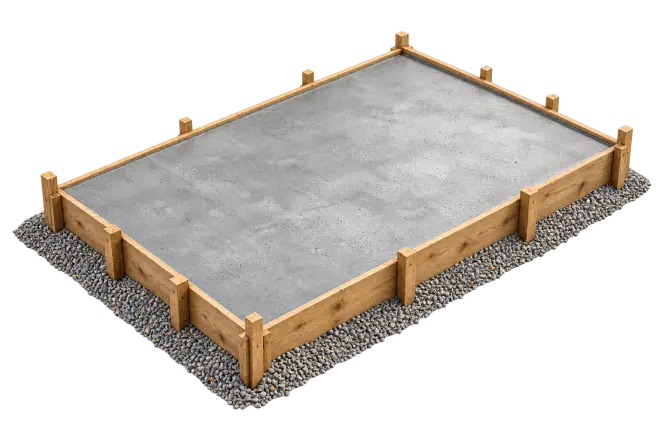
How to use this calculator
- Select the concrete form first. The calculator shows only the dimensions needed for that shape, and the 3D preview updates with your entries.
- Measure the space that will actually be filled with concrete. Use “Identical pours” only for repeated forms with the same measurements.
- Choose ready-mix volume or premixed bags. For bags, replace the starting finished yield with the number printed on the exact product. Add optional price or density only when known.
Choose the shape that matches your pour
Concrete volume starts with the space inside the forms. Select a form in the calculator above, then measure the dimensions shown below. Every example is a raw volume before waste or supplier rounding.
Rectangular slab or pad
Use this form for a pad, patio, or other pour with a rectangular footprint and one finished thickness.
Measure: Take length and width between the form boards. Measure thickness from the prepared base to the planned top surface.
Volume: Length × width × thickness
Example: A 15 ft × 12 ft pad at 5 in thickness needs 15 × 12 × (5 ÷ 12) = 75 ft³, or 2.78 yd³ before waste.
Check: A turned-down edge has extra depth. Calculate only that added portion separately so the slab thickness is not counted twice.
Concrete wall
Choose a wall when its height is much greater than its thickness, including a straight formed wall segment.
Measure: Use the full wall length, the poured height, and the clear space between the two form faces.
Volume: Wall length × wall height × wall thickness
Example: An 18 ft long wall, 6 ft high and 8 in thick fills 18 × 6 × (8 ÷ 12) = 72 ft³, or 2.67 yd³.
Check: Subtract substantial planned openings or calculate each solid wall segment separately. This form assumes one solid rectangle.
Strip footing
Estimate a straight strip footing below a wall or continuous foundation line.
Measure: Record trench or form length, the specified footing width, and the actual pour depth. Use the dimensions of the concrete cavity.
Volume: Footing length × footing width × footing depth
Example: A 24 ft run that is 2 ft wide and 12 in deep uses 24 × 2 × 1 = 48 ft³, or 1.78 yd³.
Check: A footing with stepped levels or changing width should be split into sections; do not average unlike cross sections without checking them.
Rectangular column
Use for square or rectangular posts, piers, and columns with a constant cross section.
Measure: Measure both sides of the inside base and the full concrete height from its bearing surface to the top.
Volume: Base length × base width × column height
Example: A 12 in × 16 in column that is 9 ft tall contains 1 × (16 ÷ 12) × 9 = 12 ft³, or 0.44 yd³.
Check: The volume of a separate footing below the column is not included. Calculate it as another form, then add the two raw volumes.
Round column
Choose this for a cylindrical pier or column with one diameter throughout its height.
Measure: Measure the inside diameter across the circular form, then the full height. Radius is half the diameter.
Volume: π × (diameter ÷ 2)² × height
Example: A 14 in diameter pier, 8 ft tall, uses π × (7 ÷ 12)² × 8 ≈ 8.55 ft³, or 0.32 yd³.
Check: A flared base, bell, or tapered shaft needs a separate calculation. Diameter changes have a squared effect on volume.
Round slab or footing
Estimate a circular pad or a cylindrical footing with a flat top and constant thickness.
Measure: Measure the full diameter from edge to edge, and the concrete thickness from base to top.
Volume: π × (diameter ÷ 2)² × thickness
Example: A 10 ft diameter pad at 5 in deep needs π × 5² × (5 ÷ 12) ≈ 32.72 ft³, or 1.21 yd³.
Check: Do not enter the radius as the diameter. For a ring or donut shape, subtract the inner circular volume from the outer volume.
Solid steps with platform
Estimate a solid staircase built from level step blocks, with an optional full-height top landing.
Measure: Enter the clear stair width, one tread run, one step rise, the number of rises, and any landing depth beyond the last tread.
Volume: Width × run × rise × n(n + 1) ÷ 2 + width × landing depth × (n × rise)
Example: Four 4 ft wide steps with 12 in run, 6 in rise, and a 3 ft landing use 20 ft³ in steps plus 24 ft³ in the landing: 44 ft³, or 1.63 yd³.
Check: The calculation fills the entire staircase down to the base. Hollow stairs and sloped undersides need a separate takeoff.
Curb and gutter
Estimate one continuous raised curb alongside a flat gutter strip.
Measure: Enter total run, curb depth across the cross section, curb height above the gutter, gutter width, and slab or flag thickness.
Volume: Run × [curb depth × (curb height + flag thickness) + gutter width × flag thickness]
Example: For 20 ft of run, a 6 in × 6 in curb and a 12 in gutter at 4 in thickness use 15 ft³, or 0.56 yd³.
Check: The curb cross section and adjacent gutter are added once. Slopes, transitions, and catch-basin cutouts are not modeled.
Measure the project correctly
Use inside dimensions for formed work. For a wall, measure its face height and thickness separately; for a round pier, measure the full inside diameter. A tape reading such as 12 ft 6 in can be entered directly.
Check depths after the base is prepared. If the cross section changes, split the project into separate forms and add raw volumes before applying one overall allowance.
The calculation
Convert each measurement to the same length unit before multiplying. In US units, divide an inch measurement by 12 for feet, then divide cubic feet by 27 for cubic yards.
The result breakdown shows the exact formula for the selected form. Waste is added to total volume once; the displayed purchase amount rounds up to the next tenth of a cubic yard or cubic meter for planning.
In bag mode, whole bags = round up[(raw volume × (1 + waste ÷ 100)) ÷ finished yield per bag]. Bag weight is a product identifier; its wet concrete yield is the number used in the calculation.
Worked example
For a rectangular slab example, consider one pad that measures 12 ft long, 10 ft wide, and 4 in thick, with a 5% allowance. The illustrated guide above also works through every other form.
| Step | Calculation | Result |
|---|---|---|
| Convert depth | 4 in ÷ 12 | 0.333 ft |
| Find volume | 12 ft × 10 ft × (4 ÷ 12) ft | 40 ft³ |
| Convert to yards | 40 ft³ ÷ 27 | 1.48 yd³ |
| Allow 5% waste | (40 ÷ 27) × 1.05 | 1.56 yd³ |
| Round order amount | Up to the next 0.1 yd³ | 1.6 yd³ |
If the local material price is entered per cubic yard, the cost estimate uses the rounded 1.6 yd³ purchase amount. Delivery, short-load, tax, and placement charges are outside this material-only estimate.
How to read the result
- Calculated amount
- The exact geometric volume of the selected form before waste or rounding.
- Recommended purchase
- The volume with your waste setting, rounded upward to a tenth for planning.
- Premixed bags
- Whole bags from the entered finished yield after one waste allowance. A different product may yield another volume at the same bag weight.
- Form area and conversions
- The relevant face or base area helps check dimensions; cubic feet and cubic meters help compare supplier quotes or bag yields.
Before you buy materials
Match the dropdown to the actual form before entering numbers. A 12 in round column and a 12 ft round pad have different input units and very different volumes.
Ask the supplier how they accept order quantities and whether a minimum load applies. The on-screen tenth is a planning convention, not a supplier promise.
For a bag purchase, confirm the finished yield on the exact mix label. The starting 40–80 lb yields describe QUIKRETE Concrete Mix and should be replaced for another mix.
Common estimating mistakes
- Multiplying feet by inches: Convert the inch depth to feet first; otherwise the numeric volume is twelve times too large.
- Using the outside of the forms: Measure the concrete cavity between the inside edges of the forms.
- Treating a stair as a thin slab: Use the solid steps form only when the area beneath each tread is filled; measure a hollow or sloped stair separately.
- Adding waste to each dimension: Apply the percentage once to the final volume, as the calculator does.
Assumptions and limits
- Each selected form has uniform dimensions. Solid stairs fill the space beneath the treads; hollow stairs and sloped undersides are outside this estimate.
- An opening, flared column base, tapered wall, or changing trench width needs its own measured section or a separate volume deduction.
- Waste is an adjustable planning margin, not a measurement of actual spillage or ground variation.
- Optional density estimates the weight of placed concrete only; it does not replace the product’s finished yield per bag.
- Reinforcement, subbase, forms, delivery minimums, and labor are not included.
Frequently Asked Questions
Common questions about the Concrete Calculator.
- How do I convert cubic feet to cubic yards?
- Divide cubic feet by 27. For example, 54 ft³ is 2 yd³.
- Can I calculate a round footing or column?
- Yes. Choose Round slab or footing for a circular pad, or Round column for a tall pier. Enter diameter, not radius; the calculator uses π × radius² × height.
- How are solid concrete stairs measured?
- Enter the number of rises, one tread run, one rise, stair width, and optional full-height platform depth. The formula adds each solid step prism and the landing volume.
- What if the pour has several unlike parts?
- Calculate each measured form separately and sum the raw volumes. Use Identical pours only when all selected dimensions repeat exactly.
- Can this calculate bags as well as ready-mix volume?
- Yes. Select Premixed bags, enter the finished yield printed on your product, and the calculator rounds the waste-adjusted volume up to whole bags.
- When should I use the separate Concrete Bag Calculator?
- Use it when you already know a raw pour volume and only need to compare bag weights, yields, waste, and cost.