How to use this calculator
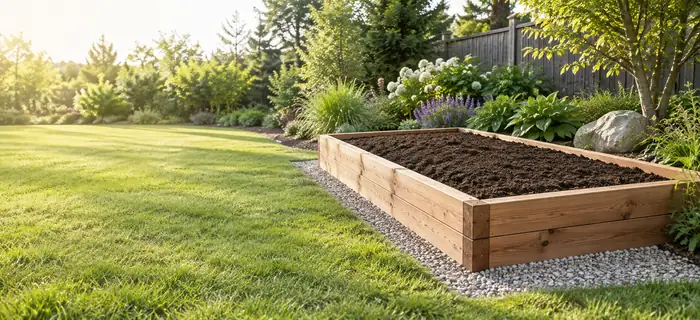
- Choose a rectangular or round bed and measure its footprint.
- Enter the desired finished topsoil depth and a project-specific extra/settling allowance.
- Enter printed bag volume and optional bag/bulk prices. Leave density blank unless a supplier gives a useful value.
Measure the project correctly
Measure the area that will actually receive new soil. Avoid counting paving, existing planted areas or structures.
Use finished layer depth above the prepared grade. If part of the lawn needs deeper filling, calculate it separately.
The calculation
No fixed compaction or settling factor is assumed. The allowance is an editable planning choice.
Bulk planning volume rounds upward to a tenth of a cubic yard or cubic meter; supplier minimums can be different.
Worked example
A 30 × 15 ft lawn receives 3 in of finished topsoil with a 10% extra allowance and 1 ft³ bags.
| Step | Calculation | Result |
|---|---|---|
| Lawn area | 30 × 15 | 450 ft² |
| Raw soil volume | 450 × (3 ÷ 12) | 112.5 ft³ |
| Allowance | 112.5 × 1.10 | 123.75 ft³ |
| Whole bags | 123.75 ÷ 1; round up | 124 bags |
| Bulk order | 123.75 ÷ 27; round up to 0.1 | 4.6 yd³ |
Compare a bulk delivery quote with bag pricing. The entered allowance is not a guarantee of settlement or a universal soil compaction factor.
How to read the result
- Measured volume
- Soil at the entered finished depth before extra allowance.
- Whole bags
- Adjusted volume divided by the exact entered bag volume.
- Bulk amount
- Adjusted volume rounded upward to a tenth.
Before you buy materials
Use bag labels for actual packaged volume and ask bulk suppliers how they sell by cubic yard or meter.
Consider soil quality and suitability separately from volume; a cubic yard estimate says nothing about composition.
Common estimating mistakes
- Treating an allowance as a universal compaction rate: Choose it for site conditions; no fixed factor is built in.
- Measuring the entire yard: Exclude areas that will not receive the new topsoil layer.
Assumptions and limits
- Uniform finished depth across a rectangle or circle.
- Existing soil, amendments, grading, drainage, delivery and labor are excluded.
Worked project guide
For a measured example, read topsoil for 1,000 square feet and compare its assumptions with your own project.
Frequently Asked Questions
Common questions about the Topsoil Calculator.
- Why does this differ from Mulch Calculator?
- Topsoil is a growing-medium layer; mulch is a surface cover with different use and material assumptions.
- Does the calculator predict soil settling?
- No. The extra allowance is your planning input; it is not a built-in settling or compaction factor.