How to use this calculator
- Select the section that matches your stock. Hollow sections subtract their voids; I, T, U, L and Z profiles count only their webs and flanges.
- Choose a material preset or enter the supplier’s density. Presets are rounded planning values, so a mill certificate or published section weight takes priority.
- Enter dimensions, stock length and identical piece count. Optional cutting allowance and unit price apply to the purchase weight, not the uncut piece geometry.
Metal stock section guide
Choose the section you are buying, then check which outside dimensions and wall or web thicknesses it needs. The original drawings show material cross-sections rather than copied product images.
Solid round bar
Measure: Nominal diameter and cut/stock length.
Method: Solid circular area multiplied by length.
Square / rectangular bar
Measure: Actual width, thickness and length.
Method: One solid rectangular section.
Hexagonal bar
Measure: Across-flats width, not corner-to-corner width, plus length.
Method: Regular hexagon area is √3 ÷ 2 × across-flats².
Flat sheet or plate
Measure: Actual sheet length, width and thickness.
Method: Flat rectangular plate volume.
Round pipe / tube
Measure: Outside diameter, wall thickness and pipe length.
Method: Outer circular area minus the open bore.
Profile by section area
Measure: Manufacturer section area and stock length.
Method: Uses published material area directly; the pictured section is a placeholder.
L angle
Measure: Both outer leg sizes, common thickness and length.
Method: Two joined strips with the corner counted once.
U channel
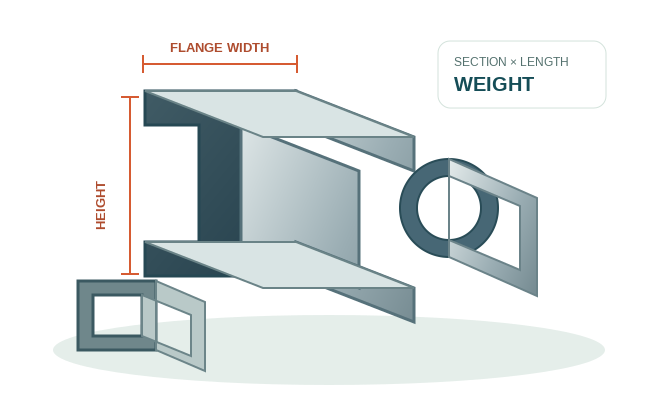
Measure: Outer height, flange width, common thickness and length.
Method: Two flanges plus a clear web.
I / H beam
Measure: Outer height, flange width, web thickness, flange thickness and length.
Method: Two flange rectangles plus the central clear web.
T section
Measure: Outer height, flange width, web/flange thicknesses and length.
Method: One top flange plus the web below it.
Square hollow section
Measure: Outer side length, nominal wall thickness and stock length.
Method: Outside square minus the hollow inside square.
Rectangular hollow section
Measure: Outer width/height, nominal wall thickness and stock length.
Method: Outside rectangle minus the inner void.
Z purlin
Measure: Overall depth, flange width, common thickness and length.
Method: Opposite flanges plus the connecting web.
Round base plate
Measure: Outside disc diameter and actual plate thickness.
Method: Circular face area times plate thickness.
Reinforcing bar
Measure: Nominal bar diameter and cut length.
Method: Nominal circular area; raised ribs are not added to geometric mass.
Section drawings explain geometry. Formed corners, ribs and mill tolerances need supplier section data for precise procurement weight.
Measure the project correctly
For a bar or pipe, use outside diameter. For a hex bar, measure across two opposite flats. For pipe and hollow sections, measure nominal wall thickness separately.
For a beam, measure overall height, flange width, web thickness and flange thickness. Profile by section area lets you use a manufacturer’s published area when its rolled shape is more complex than an ideal sharp-corner sketch.
The round base-plate option uses diameter and thickness rather than a stock length. Reinforcing bar uses nominal smooth circular area; ribs shown in the visual are schematic.
The calculation
All dimensions convert to meters before volume is multiplied by density in kg/m³. Display pounds use 1 lb = 0.45359237 kg.
Pipe area is π(OD² − ID²)/4 with ID = OD − 2 × wall. Rectangular hollow section area is outer width × outer height minus the inner rectangle. A beam adds its two flange rectangles and clear web rectangle.
Rolled sections have corner radii, variable design thickness, fillets and tolerances. The ideal formulas are transparent estimates; published mill mass per length is better when procurement precision matters.
Worked example
Estimate six carbon-steel round bars, each 10 ft long and 1 in in nominal diameter, using 7,850 kg/m³ density and no cutting allowance.
| Step | Calculation | Result |
|---|---|---|
| Convert diameter | 1 in × 0.0254 | 0.0254 m |
| Cross-section area | π × 0.0254² ÷ 4 | 0.0005067 m² |
| Length per bar | 10 ft × 0.3048 | 3.048 m |
| Mass per bar | 0.0005067 × 3.048 × 7,850 | 12.13 kg |
| Six bars | 12.13 × 6 | 72.80 kg ≈ 160.50 lb |
If you add a 5% cutting allowance, the planning purchase weight becomes about 76.44 kg. It does not change the physical weight of the six finished bars.
How to read the result
- Weight per piece
- The ideal geometry of one measured item at the entered density.
- Total without allowance
- Weight per piece multiplied by identical piece count.
- Weight with allowance
- Planning purchase weight after one cutting allowance, used for optional unit-price cost.
- Section area
- Material-only section area; pipe and hollow-section voids are excluded.
Before you buy materials
AISC publishes official shape dimensions and section properties. Use a designated section’s published area or weight per length when exact procurement is needed.
NIST lists steel at 7,850 kg/m³ as a common reference; the Aluminum Association lists 6061 aluminum near 2,700 kg/m³. Verify the exact grade and product before ordering.
Compare your selected price unit with the quote. US mode prices per pound; Metric mode prices per kilogram, and switching units converts the entered rate.
Common estimating mistakes
- Treating a hollow tube as solid: Choose pipe or HSS and enter the outside size plus wall thickness.
- Confusing nominal and actual section size: Use measured or published dimensions, especially for rolled profiles.
- Entering hex corner-to-corner size: This calculator expects the across-flats distance.
- Applying cutting allowance to each dimension: The percentage is applied once to finished total mass.
Assumptions and limits
- Simple sharp-corner cross-sections are assumed for fabricated angles, channels, beams and hollow sections. Rebar rib effects are not included in its nominal circular area.
- Material density values are editable planning examples. Actual density depends on alloy and specification; coating, moisture, weld metal, attachments and fasteners are excluded.
- Cutting allowance is a mass-based purchase margin. It does not lay out cuts against available stock lengths or calculate offcut reuse.
Frequently Asked Questions
Common questions about the Metal Weight Calculator.
- Can I use another metal or alloy?
- Yes. Choose Custom density and enter the material density from your specification or supplier.
- Are hollow-section corner radii included?
- No. The displayed geometry uses ideal sharp corners; use the manufacturer’s section area or published unit weight for exact profile mass.
- How is rebar weight calculated?
- The calculator uses nominal diameter as a smooth circular section times length and density. Actual bar mass is governed by its product specification.
- Can I enter a published section area?
- Yes. Choose Profile by section area, then enter the manufacturer’s area, stock length, quantity and density.