How to use this calculator
- Choose the closest inside form. A horizontal cylinder and a vertical cylinder with the same dimensions do not have the same partial-fill curve.
- Enter only the dimensions shown for that form. Straight barrel height excludes added dome, cone or hopper height; capsule straight length excludes its round ends.
- Measure liquid level vertically from the lowest inside point. Enter zero for empty, or the full interior height shown in the results for a full vessel. Switch US/Metric to convert all entered measurements.
Tank shape and level guide
Match the actual inside vessel form before you read its level. These original drawings show the distinctive geometry of each option; the calculator above uses exact dimensions.
Rectangular tank
Measure: Inside length, width, height; level from the flat floor.
Method: Each horizontal layer has the same rectangular area.
Horizontal cylinder
Measure: Inside diameter and straight barrel length; level from the lowest curve.
Method: The wetted circular chord widens toward the center and narrows again.
Vertical cylinder
Measure: Inside diameter and vertical wall height.
Method: Constant circular area means filled volume rises evenly with level.
Horizontal capsule
Measure: Straight barrel length and inside diameter; rounded ends add one diameter overall.
Method: A horizontal barrel joins two hemispherical ends.
Vertical capsule
Measure: Straight barrel height and inside diameter; two domes add one diameter.
Method: Bottom and top curved ends change volume per inch near the ends.
Horizontal elliptical tank
Measure: Straight length plus inside ellipse width and height.
Method: Elliptical chord width changes with liquid height; ends are flat.
Vertical elliptical tank
Measure: Two perpendicular inside floor diameters and straight wall height.
Method: A constant elliptical floor area extends vertically through the tank.
Cylinder with cone bottom
Measure: Inside barrel diameter, straight wall height, and lower cone height.
Method: A narrow lower cone joins a constant-area cylinder.
Cylinder with cone top
Measure: Inside diameter, straight wall height, and upper cone height.
Method: A constant-area cylinder narrows to a top apex.
Cylinder with dome top
Measure: Inside diameter, straight wall height, and spherical-cap rise.
Method: A curved cap adds volume above a straight circular body.
Dome top + cone bottom
Measure: Diameter and separate cone, straight-wall, and dome heights.
Method: Three stacked sections share the same circular joining diameter.
Dome top + offset cone bottom
Measure: The same three heights, with the cone outlet offset from center.
Method: Offset changes the pictured outlet, while horizontal slice area stays equal.
Offset cone bottom
Measure: Diameter, straight-wall height, and vertical height to the offset outlet.
Method: A displaced cone apex sits below the circular barrel.
Spherical tank
Measure: Full inside diameter and level from the bottom.
Method: Spherical slices are smallest near the bottom and top.
Full conical vessel
Measure: Wide lower inside diameter and full height to the top point.
Method: The circular section tapers continuously toward the apex.
Tapered frustum tank
Measure: Separate inside bottom/top diameters and vertical height.
Method: A tapered circular tank keeps flat ends of different sizes.
Rectangular hopper bottom
Measure: Upper inside length/width, flat outlet size, straight height, and hopper height.
Method: A centered rectangular outlet expands to the full upper footprint.
Rectangular sloped-floor tank
Measure: Inside length/width, top height and floor rise from low to high end.
Method: A planar wedge removes capacity and changes the wet footprint at low levels.
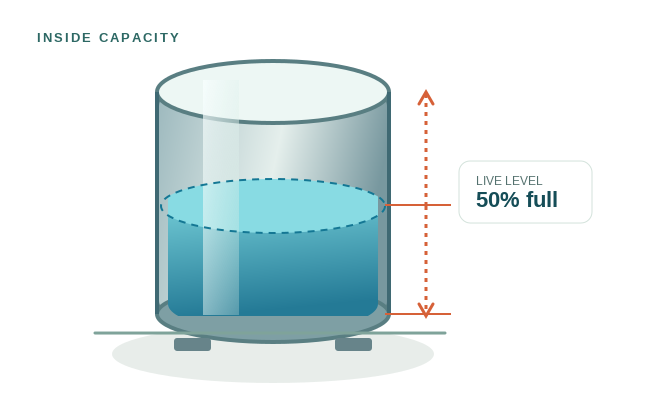
Shape drawings show an illustrative liquid level. Entered dimensions and liquid height control the live 3D model and calculations.
Measure the project correctly
Use clear internal length, width, diameter and height. External dimensions overstate volume by the wall thickness; internal pipes, baffles and fittings also displace liquid.
A capsule here has two true hemispherical ends. An elliptical horizontal tank has a constant elliptical cross-section and flat ends. Dome tops are spherical caps with the entered rise, not an arbitrary decorative roof.
For a rectangular hopper, measure its smaller flat outlet and vertical hopper height. For a sloped floor, measure the rise between low and high ends of one planar floor.
The calculation
Rectangular tanks use constant length × width slices. Round vertical tanks use constant πr² slices; horizontal round and elliptical tanks use the shrinking chord width at each height. Spheres, capsule ends, cones, domes and hoppers use their exact changing section areas.
A right cone and an offset (oblique) cone with the same horizontal circular base and vertical height have the same horizontal slice area at every level. Their 3D appearance and outlet position differ, but their liquid-volume curves match.
The calculator uses numerical integration for partial fills. This also keeps combined vessels such as dome-top cone-bottom tanks consistent with their selected bottom, middle and top sections.
Worked example
Consider an inside rectangular water tank 10 ft long, 6 ft wide and 6 ft tall. The measured water level is 3 ft above the floor.
| Step | Calculation | Result |
|---|---|---|
| Inside floor area | 10 ft × 6 ft | 60 ft² |
| Water volume | 60 ft² × 3 ft | 180 ft³ |
| Convert to US gallons | 180 ft³ × 7.48052 | 1,346.5 US gal |
| Full capacity | 60 ft² × 6 ft × 7.48052 | 2,693.0 US gal |
| Free space | 2,693.0 − 1,346.5 | 1,346.5 US gal |
A half-height reading is exactly half the capacity for this straight rectangular tank. It is not half the volume in most horizontal round, tapered or domed tanks.
How to read the result
- Liquid volume
- Volume below the entered vertical level inside the selected shape.
- Full inside capacity
- Geometric volume up to the top interior point, with no operating freeboard deducted.
- Unfilled space
- Full capacity minus present liquid volume.
- Percent full by volume
- Liquid volume divided by full capacity; it is generally different from fill height divided by total height.
Before you buy materials
Use a manufacturer calibration chart for custody transfer, regulatory reporting or a tank with complicated heads. This calculator is for geometric planning.
Keep operational freeboard and unusable liquid below an outlet separate from the full geometric capacity.
Choose US gallons or liters to match the specification. The same physical tank is converted when you switch units.
Common estimating mistakes
- Using outside measurements: Measure the clear interior space or obtain the tank drawing.
- Reading fill against a curved end as a percentage: Enter the vertical level; the tool computes the shape-specific volume curve.
- Including capsule end length in straight barrel length: Enter only the straight run; two hemispherical ends add one diameter overall.
- Treating capacity as a safe operating fill: Apply your required freeboard, overflow and outlet rules separately.
Assumptions and limits
- Forms are mathematically ideal and smooth. Real fabricated tanks may have rounded seams, nozzles, internal equipment, wall thickness, or nonstandard heads.
- Horizontal tanks are level. A tank tilted along its length needs a surveyed slope and a different fill model.
- Liquid is level and its free surface is horizontal. This is volume geometry, not structural design, safe working capacity or a pressure-vessel rating.
- For an offset cone, the outlet is displaced in the 3D model while horizontal circular section areas remain those of the entered cone.
Frequently Asked Questions
Common questions about the Tank Volume Calculator.
- Why is a half-full horizontal cylinder not always half-full by height?
- A level exactly at the center is half its volume, but other height percentages do not map linearly to volume because each horizontal chord has a different width.
- Are gallons US gallons?
- Yes. One US liquid gallon is exactly 3.785411784 liters.
- Can I enter zero liquid level?
- Yes. Zero shows an empty tank; the full inside capacity stays visible.
- What is the difference between a dome and a capsule?
- A capsule has hemispherical ends on both sides of a straight cylinder. The dome-top options have only a top spherical cap and may combine it with a conical bottom.
- Does the tank model include wall thickness?
- No. Enter actual inside dimensions; the translucent wall is a visual guide and does not change the liquid calculation.